
The Federal Conservatives have urged both the auditor general and the Parliamentary Budget Office (PBO) to investigate whether the Liberal government’s approach to acquiring airborne early warning aircraft from the Swedish manufacturer Saab adhered to the proper procedures.
Earlier this month, sources informed CBC News that the GlobalEye, selected by the government for the air force, only satisfies a limited number of the military’s requirements and will require significant modifications.
In a statement addressing the initial report by CBC News, the Defence Investment Agency (DIA) acknowledged that none of the three aircraft under review met the requirements of the air force, asserting that the GlobalEye was nevertheless the optimal option.
The basis for this conclusion remains unclear, as none of the competing firms had access to the air force’s requirements prior to Prime Minister Mark Carney’s announcement at Canada’s largest arms trade show, CANSEC, at the end of May.
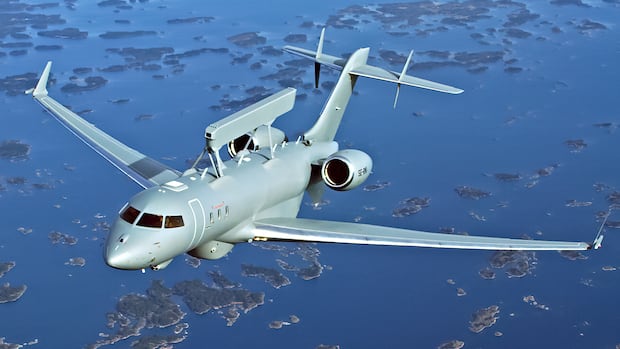
Sources tell CBC News that Canada’s decision to purchase the Saab GlobalEye surveillance aircraft was made without understanding the military’s actual needs. Critics argue that the aircraft currently fulfills only a few of Canada’s requirements and will require modifications.
In a statement released late Friday, the Conservatives emphasized the necessity for public assurance that the DIA conducted thorough due diligence before initiating the acquisition process.
“Canadians have a right to know if political agendas took precedence over national security, defense, and operational readiness,” stated Conservative defense critic James Bezan.
“It is essential for the auditor general and PBO to ascertain whether proper considerations were made and if protocols were followed.”
“Promoting Canadian industry is not a matter of favoritism or politics; it is a way to fortify our nation. Our government remains committed to enhancing Canada’s defense capabilities while prioritizing Canadian enterprises,” remarked Sofiya Sapeha, spokesperson for the Secretary of State for Defence Procurement.
“The GlobalEye represents the best option for the CAF, Canada’s expanding defense sector, and Canadian taxpayers. Modifying Bombardier’s Global 6500 in Canada will generate thousands of well-paying jobs while bolstering Canadian sovereignty by ensuring the CAF has the necessary equipment.”
The call for an examination of the procurement plan falls within the auditor general’s jurisdiction to investigate if appropriate protocols and controls were observed. The PBO is better equipped to evaluate the costs, financial assumptions, and fiscal risks associated with the GlobalEye decision once a contract with Saab is finalized.
According to sources, the military is worried that the aircraft, as it stands, lacks 360-degree radar coverage. Additionally, there are concerns regarding the radar’s range and frequency.
Saab has suggested modifications, which include adding extra radar systems in the aircraft’s nose and tail.
-
Canada negotiating to buy Saab’s GlobalEye airborne early warning aircraft
-
Canada ready to further distance itself from U.S. on military procurement
-
Ottawa to spend almost $2B over 4 years to buy 190 Canadian-made armoured vehicles
There are additional concerns regarding the number of crew stations and the connectivity equipment necessary for linking the aircraft into the NORAD network, which would hinder the GlobalEye’s ability to perform a “control” role in operations involving multiple military assets.
The military is also looking for a radar aircraft that can be refueled mid-flight to cover the extensive Arctic regions, a capability not currently incorporated in the GlobalEye.
In prior interviews, Saab has stated that it is ready to meet the demands of its clients and is aware of the expectations of the Canadian military, actively working through engineering challenges.
In response to the initial report from CBC News, Sapeha clarified the difference between the “government’s requirements” and “military requirements.”
Sapeha expressed confidence that the GlobalEye satisfies the “government’s requirements.”
She mentioned that over the past several months, the government has been working on the specifics of a term sheet for the intended procurement. A term sheet is a preliminary, non-binding document that details the fundamental terms and conditions for a proposed agreement.
“Discussions have taken place regarding which additional capabilities beyond Saab’s baseline could enhance the aircraft, the extent of technical and financial risk, operational utility, and the timing of proceeding—whether now, later, or not at all,” Sapeha stated.
“These dialogues are routine and do not suggest that Saab’s aircraft has deficiencies or has failed to meet the government’s requirements. The aircraft meets the government’s requirements.”
Tag: rewrite-pending

