
Canada’s highest court has determined that Elections Canada made a significant administrative mistake that could compromise the integrity of the electoral system when it neglected to resolve issues related to mail-in ballots in a Montreal-area district prior to the 2025 federal election.
The Supreme Court of Canada annulled the election results for the Terrebonne riding in a ruling issued in February, with the reasons for this decision released on Friday.
The court stated that its ruling for a new election “bolsters public confidence in the electoral process by confirming that a federal election should not be influenced by identifiable and rectifiable official errors,” according to the decision.
Liberal candidate Tatiana Auguste was proclaimed the victor in the Terrebonne riding, narrowly defeating incumbent Bloc Québécois candidate Nathalie Sinclair-Desgagné by a margin of just one vote in April 2025.
The Bloc candidate contested the election results and called for a byelection after a Bloc supporter reported that she had attempted to vote by mail with a special ballot that was never counted.
The voter, Emmanuelle Bosse, indicated that her special ballot was returned to her mailbox due to an error in the postal code on a label provided by Elections Canada.
A judge from the Superior Court dismissed Sinclair-Desgagné’s request for a new election; however, the Supreme Court overturned that ruling in a split decision announced from the bench in February, leading to a byelection that Auguste secured on April 13.
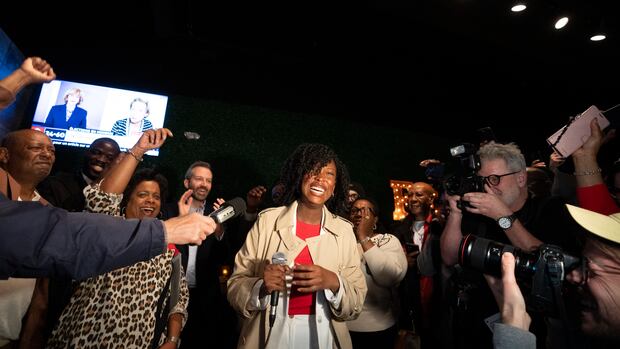
After a challenging year, the Liberals’ Tatiana Auguste will serve as the representative for the Quebec riding of Terrebonne in the House of Commons. She triumphed in Monday’s byelection, winning by over 700 votes against Bloc Québécois’ Nathalie Sinclair-Desgagné.
Justice Mahmud Jamal, writing for the majority, noted that an employee of Elections Canada had been aware for weeks that several voters received envelopes with incorrect postal codes, yet the agency failed to act to rectify the situation.
The decision indicated, “Elections Canada did not count or receive an elector’s vote because it failed to take adequate measures to rectify the mistake, even though it was aware of its error and anticipated that affected voters would be contacted by one of its employees.”
“Elections Canada was responsible for the mistake and had both the capacity and obligation to correct it.”
The court learned that an employee had distributed improperly addressed envelopes for mail-in ballots to around 40 voters.
This employee became aware of the error more than three weeks prior to election day but did not inform any supervisors, believing that the mistake was not causing any issues “since the Terrebonne polling station was receiving completed special ballots as usual, including those in envelopes with the postal code error,” the ruling stated.
Prime Minister Mark Carney’s Liberals secured the riding outside Montreal by approximately 700 votes in Monday’s byelection. Tatiana Auguste had initially won the riding by a single vote in April 2025, a result that was later invalidated by the Supreme Court of Canada due to an uncounted mail-in ballot.
Jamal indicated that the Superior Court made an error in determining that an inadvertent administrative error was not substantial enough to be classified as a voting irregularity.
“Unintentional, honest, or good faith errors can also compromise the integrity of the electoral process if they inhibit electors from exercising their voting rights,” the judge remarked.
Elections Canada stated in a release that it evaluated its special ballot process following the election and has implemented changes. The agency noted it would carefully analyze the Supreme Court’s decision before determining any further actions.
“Elections Canada continually seeks new methods to better equip the tens of thousands of personnel responsible for facilitating federal elections,” the agency mentioned in the announcement.
-
Quebec Liberal leader criticizes decision to send voter guides in French only in letter to premier
-
PQ leader expresses concern over potential interference from Ottawa in Quebec election
-
The Alberta NDP won Calgary’s byelection. However, the electoral map may change significantly for the next election.
The ruling was decided by a vote of 6-3.
In dissent, Justices Andromache Karakatsanis and Sheilah Martin argued that the clerical error was not severe enough to warrant the extraordinary measure of rerunning an election.
They cautioned that this decision could lead to an increase in future challenges.
“If this error affecting a single vote is sufficient to challenge an election result, it’s difficult to determine what type of mistake would not meet this threshold,” they stated. “Such a low standard could jeopardize all election outcomes, undermining the stability, certainty, and finality of election results.”
The majority, however, emphasized that the standards for overturning an election remain rigorous, asserting that this ruling will not “open floodgates” to electoral disputes resulting from every mistake made during an election.

